
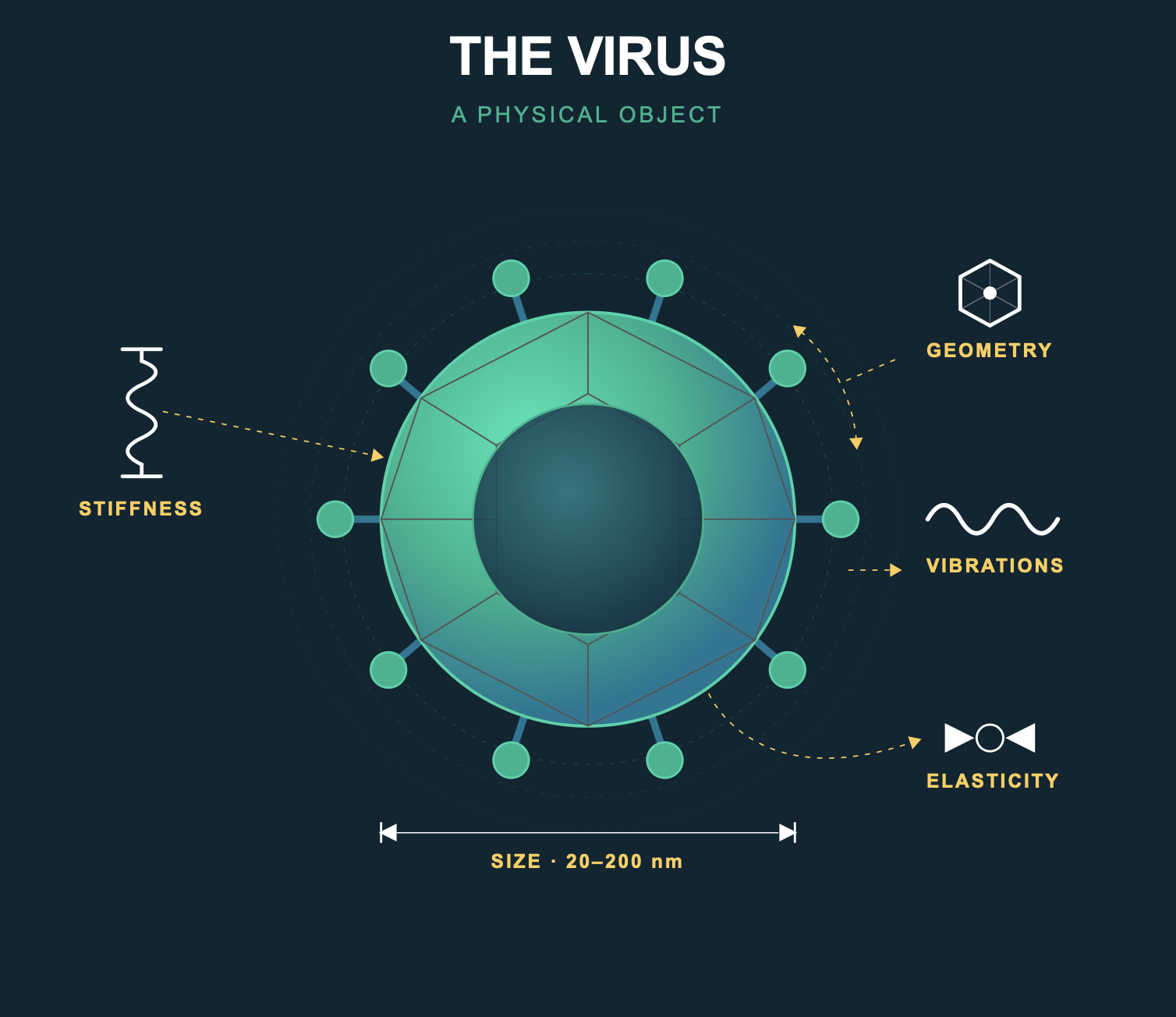
A virus isn’t just a biological entity. It’s also a real physical object. And understanding its mechanics, including the way it literally vibrates, changes everything.
When most people think about how viruses work, they think about genes. A virus injects its genetic code into a cell, hijacks the cell’s machinery, and produces copies of itself. That’s the standard story, and it’s accurate, as far as it goes.
But it leaves out something crucial: the physics.
Viruses are nanoparticles. Extraordinarily small ones, most are between 20 and 200 nanometres across, thousands of times smaller than a human hair. And like any physical object, they have structural and mechanical properties: size, shape, stiffness, elasticity, and vibrational behaviour.
These properties aren’t separate from the biology. They ‘are’ the biology, expressed in physical form.
The Virus Sings
Here is something that most people don’t know: every virus particle vibrates.
Not in a metaphorical sense. Literally. The protein shell of a virus has characteristic low-frequency vibrational modes, below 1.5 THz, determined by its size, shape, composition, and mechanical properties. These are whole-particle vibrations: the entire virus particle resonating like a tiny bell or tuning fork, with a frequency that is unique to its physical structure.
In 1969, physicists Pierre-Gilles de Gennes and M. Papoular hypothesised that these vibrations must exist in viruses and are likely involved in their biological activity. Decades of theoretical work have confirmed this. The VIRUSONG project is named for this idea: the vibration of a viral particle is its *song*.
From Assembly to Infection: The Physical Story
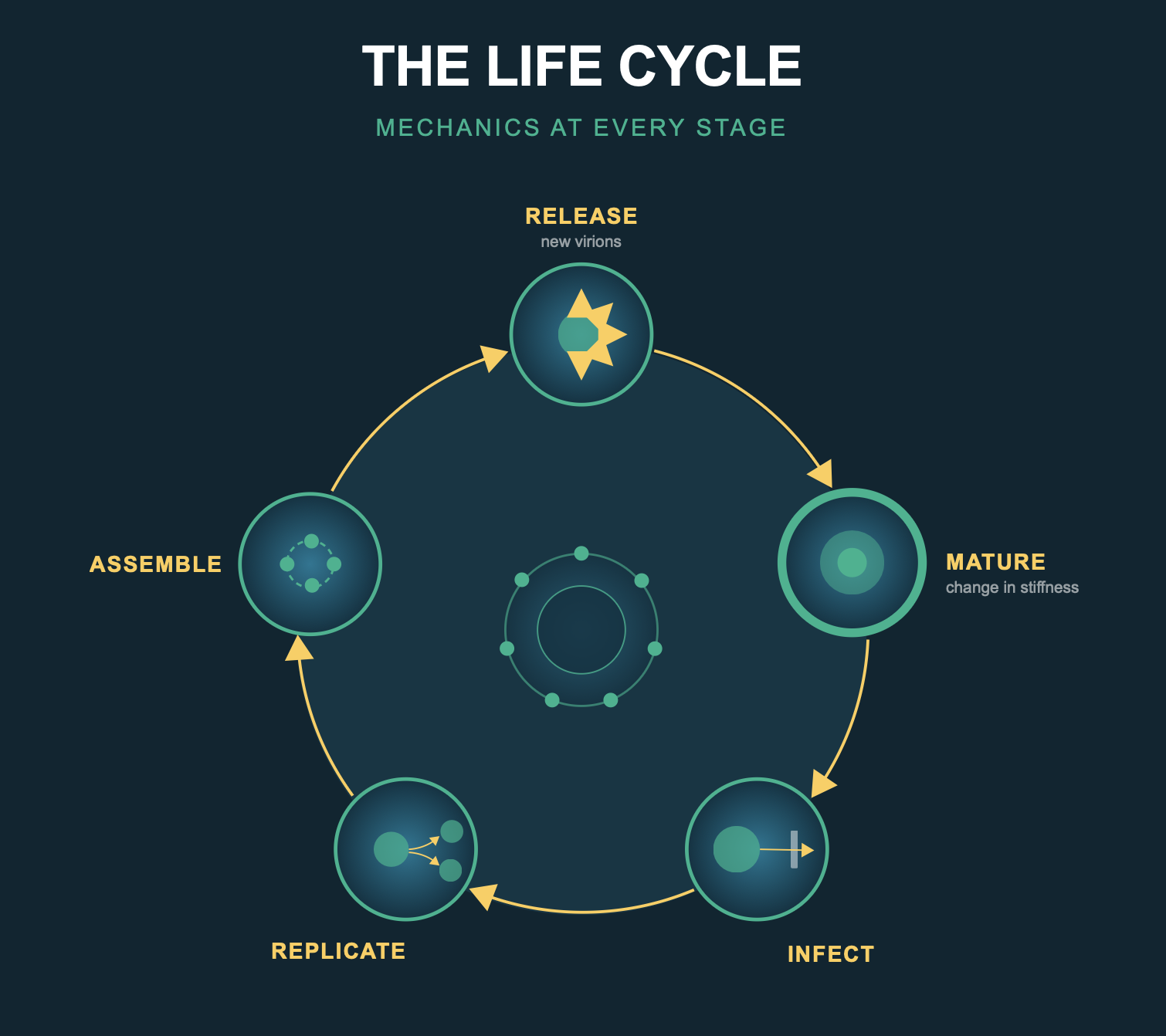
The virus life cycle begins with assembly. Protein subunits fold and click together into the capsid, the outer shell surrounding the genetic material. In enveloped viruses, a lipid membrane then wraps around the capsid, studded with surface proteins. This process is self-organising, governed by the same physical forces that shape crystals and molecular structures.
The resulting capsid has a specific geometry and mechanical stiffness. These are not incidental features. During maturation, newly assembled particles undergo structural changes, the capsid stiffens and reshapes. In many viruses, this stiffening step is essential for infectivity. An immature virus particle is measurably less rigid than a mature one.
When the virus encounters a host cell, mechanical forces determine what happens next. The virus must exert physical pressure, deform slightly, and ultimately fuse with or penetrate the cell membrane. The elasticity of the capsid matters here, as does the pressure generated by the genetic material packaged inside.
After replication, newly produced virions must be robust enough to survive in the environment until they reach the next host. That survival depends on the mechanical properties of the capsid: its stiffness, its resistance to thermal fluctuation, its structural integrity under stress.
Why VIRUSONG Studies Mechanics
VIRUSONG uses two complementary light-based techniques to measure these physical properties. Spontaneous and Stimulated Brillouin Scattering (SBS) detects the low-frequency whole-particle vibrations, the virus’ « song. » Stimulated Raman Scattering (SRS) probes the molecular fingerprint at higher frequencies.
Together, these measurements can characterise a virus’ size, shape, stiffness, and composition, in a single measurement, in a matter of minutes, without any labels.
What we find, consistently, is that the mechanical properties of a virus are not static. They evolve across the life cycle. And those changes correlate with infectivity, host range, and response to treatment.
A New Map of Vulnerability
Understanding the physical life cycle of a virus reveals potential intervention points that have nothing to do with genes or surface proteins. If a virus must reach a specific mechanical state to become infectious, what happens if we prevent that transition? If the capsid must achieve a certain stiffness to package its genome, could we design a compound that disrupts that process?
These are the questions that open up when you look at viruses as physical objects. VIRUSONG is building the measurements and models that make them answerable.